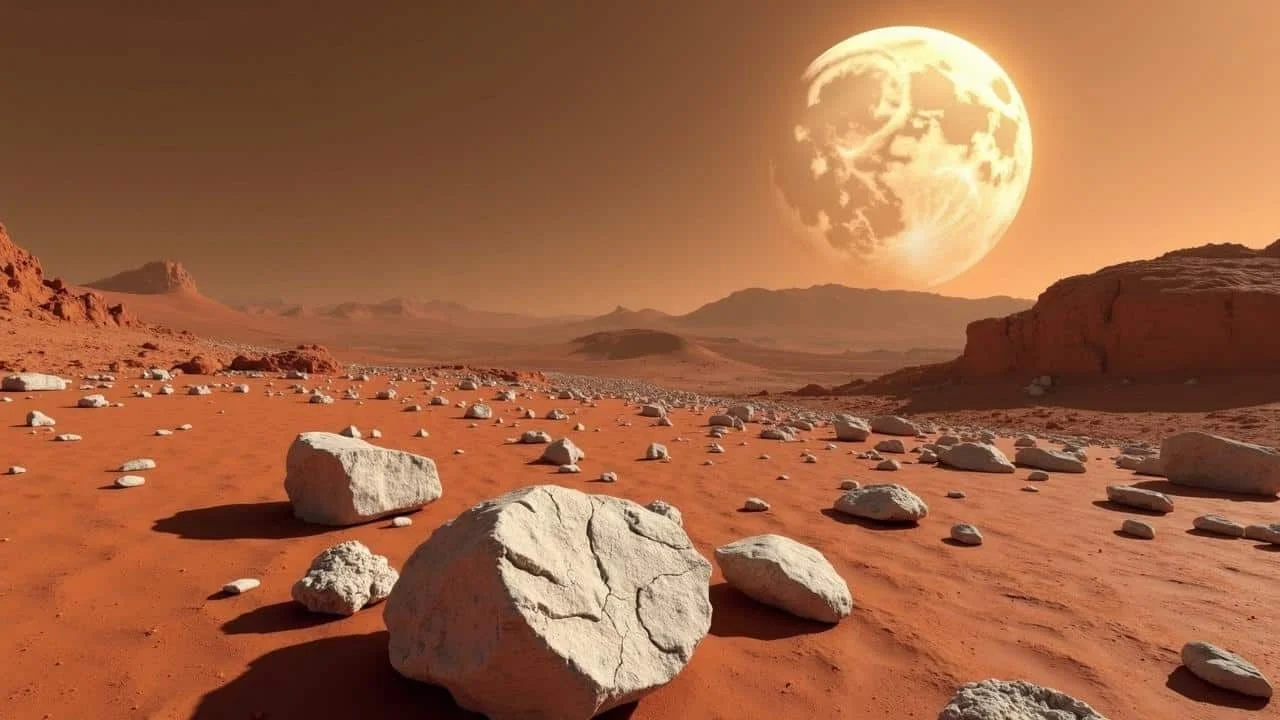
White rocks on Mars: The discovery of white rocks on Mars has flipped the script on everything scientists thought they knew about the Red Planet. When NASA’s Perseverance rover landed in Jezero Crater, it spotted pale, almost glowing rocks that stood out sharply against Mars’ rusty red soil. These white formations did not just look unusual—they held secrets billions of years old.
For years, the general belief was that Mars was a frozen desert, occasionally warmed by short-lived events. But now, the white rocks on Mars are telling a different story. They hint at a world that might have once been warm, wet, and even tropical. In this article, we will walk through what these rocks are made of, why they are significant, how they got there, and what this means for the possibility of ancient life on Mars.
White rocks on Mars: A key to a lost tropical world
Scientists were not expecting to find anything like these clay-rich, white rocks in Jezero Crater. On Earth, such minerals, especially kaolinite, are created in warm, rainy environments over millions of years. This discovery points to the possibility that Mars once had tropical-like weather, with consistent rainfall and stable temperatures. That completely changes how we look at the planet’s past.
These white rocks on Mars are not embedded into bedrock. They are loose fragments that were either carried by water or thrown in by impact events. Their chemical makeup is similar to deeply weathered tropical soils found in places like South Africa and southern California. High levels of aluminium and titanium with almost no iron suggest that these rocks went through intense chemical weathering, most likely with water being involved. That is a strong clue that Mars was not always the dry, frozen planet we see today.

Overview Table: What the White Rocks Reveal
| Key Detail | What It Tells Us |
| Location | Jezero Crater on Mars |
| Main Mineral | Kaolinite, a clay linked to tropical climates |
| Appearance | Pale white rocks scattered across red Martian soil |
| Instrument Used | SuperCam and Mastcam-Z from Perseverance rover |
| Aluminium Content | Over 30 percent, indicating strong water-driven weathering |
| Iron Content | Less than 1 percent, showing iron was leached out |
| Earth Comparison | Similar to soils in tropical areas like South Africa |
| Formation Conditions | Warm temperatures and heavy rainfall |
| Age Estimate | Around 3 billion years old |
| Scientific Meaning | Mars once had stable, warm, and habitable conditions |
A tropical signal hidden in white Martian rocks
These kaolinite-rich rocks hold more than just chemical data. They hold climate records. The fact that they are float rocks, meaning they were moved from elsewhere, shows that water was flowing across Mars long enough to break down minerals and transport debris. Their mineral content, especially the lack of iron, supports this. On Earth, similar chemical signals are found only in places with constant moisture and heat.
Rainwater likely passed through the rocks for thousands or even millions of years. This type of slow transformation is not something that happens in brief wet periods. It requires a steady climate. In other words, Mars might not have been just briefly warm—it could have had a long-lasting tropical phase.
Why kaolinite points to a warm, wet Mars
Kaolinite does not just appear overnight. It needs stable environmental conditions to form. The presence of kaolinite in the white rocks on Mars proves that Mars once had both the water and warmth needed for clay to develop. Scientists estimate the area would have received over 1,000 millimeters of rainfall each year.
Mars had to maintain above-freezing temperatures consistently to support that kind of water cycle. This is not about a few melting ice caps or random floods. This is about a climate that supported flowing or standing water for long periods. That environment is the exact type that microbial life thrives in here on Earth.

What Perseverance actually measured
The Perseverance rover used two high-tech instruments—SuperCam and Mastcam-Z—to scan and analyze the white rocks on Mars. One sample, nicknamed “Chignik,” showed unusually high aluminium and titanium levels and very low iron content. These are classic signs of heavy chemical weathering, something that only happens with lots of water.
The instruments picked up infrared signals pointing to hydroxyl groups, which are tied to the mineral kaolinite. These signals confirmed that water had been part of these rocks’ history and that it stayed locked in the clay structure for billions of years.
Two possible origins of the kaolinite rocks
There are two main ideas about how these white rocks ended up in Jezero Crater:
- River Transport: Ancient Martian rivers might have carried rocks from a faraway weathered region into the crater.
- Impact Transport: A meteor could have struck Mars, sending kaolinite-rich material flying into the crater from elsewhere.
Both theories support the same big idea—Mars had places where water flowed for a very long time. Whether these rocks were washed in or blasted in, they could only have come from areas that were once humid and warm.

What this means for Mars’s missing water
One of the overlooked facts about kaolinite is its ability to hold onto water. Even after 3 billion years, the white rocks on Mars still have chemical signatures showing that water is trapped inside. Mars may not have lost all its water to space. A good amount might still be locked up in the planet’s clay-rich surface.
Unlike Earth, Mars does not have tectonic activity to recycle minerals. So once water gets trapped in clay, it stays there. This could mean a large part of Mars’ missing water never went anywhere. It just changed form and stayed hidden in the ground.
Could a tropical Mars have been habitable?
If life ever had a shot on Mars, this was the time. These white rocks formed under the exact conditions needed for microbial life—steady warmth, flowing water, and long-term environmental stability. On Earth, similar clay-rich soils support rich ecosystems filled with bacteria, fungi, and other life forms.
That is why Perseverance is collecting rock samples for future return missions. Scientists are eager to examine them for signs of past life, including tiny fossils, isotope changes, or chemical markers. The white rocks on Mars could end up being the key to answering one of humanity’s biggest questions: was there ever life beyond Earth?

Putting “tropical Mars” into context
Understanding minerals like kaolinite helps decode what early Mars was like. These are not just technical terms—they are the language of the planet’s climate history. On Earth, we see similar soils in places that were once lush, humid, and full of life.
Now, scientists are running climate models to figure out how Mars stayed warm for so long. Some believe Mars once had more greenhouse gases, like hydrogen, that helped trap heat. Others think warm periods came in long stretches followed by colder phases. Either way, these white rocks on Mars remain the strongest evidence of a time when Mars might have looked more like Earth than we ever imagined.
FAQs
What do the white rocks on Mars tell us?
They reveal that Mars once had warm, tropical conditions with heavy rainfall and long-lasting surface water.
Why is kaolinite important in Martian research?
Kaolinite only forms with constant water flow and warmth, proving Mars had a stable climate in the past.

How did these rocks reach Jezero Crater?
They were likely carried by ancient rivers or scattered by meteor impacts from distant locations.
Is there still water in these Martian rocks?
Yes, the rocks contain chemically trapped water that has remained inside them for billions of years.
Could Mars have supported life during this tropical phase?
Absolutely. The environment was ideal for microbial life, similar to tropical regions on Earth where life thrives.