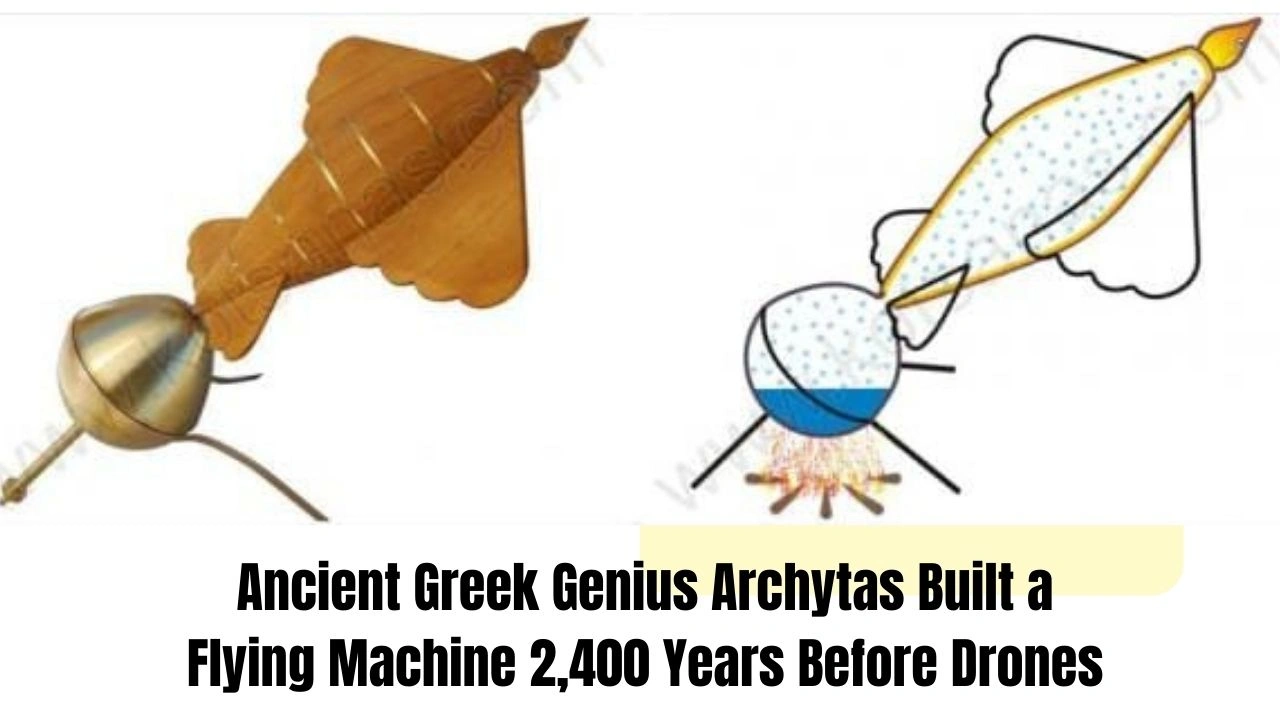
The idea of a flying machine often makes us think of modern drones, advanced engines, and futuristic aircraft. Yet this concept began far earlier than most people imagine. More than 2,400 years ago, the ancient Greek thinker Archytas of Tarentum designed a device that amazed the ancient world. His wooden pigeon was said to lift itself into the air using steam power, proving that the dream of flight was not limited to modern minds. This early blend of science and imagination shows just how ahead of his time Archytas truly was.
In this article, you will discover how the flying machine created by Archytas became one of the first recorded attempts at mechanical flight. This story explores who Archytas was, how his invention worked, and why this simple wooden bird still matters today. You will get a clear view of how one idea helped set the foundation for modern engineering and technology.
The Origins of the Flying Machine
The ancient flying machine created by Archytas was more than a technical experiment. It was a bold statement that nature could be understood and recreated through knowledge. Archytas believed that mathematics shaped everything in the universe, and he used that belief to design a bird that moved through the air using steam pressure. Although the pigeon did not fly long distances, it was a major achievement for its time. It proved that motion could be created with precise calculation and human creativity. This early vision of flight inspires engineers, historians, and technology lovers even today because it shows how innovation often begins with a single daring idea.
Overview Table
| Key Detail | Summary |
| Inventor | Archytas of Tarentum |
| Time Period | 5th century BC |
| Region | Magna Graecia, southern Italy |
| Main Invention | Steam powered wooden pigeon |
| Purpose | Explore mechanical motion using mathematics |
| Significance | One of the earliest flying machines |
| Philosophical Influence | Strong Pythagorean background |
| Scientific Contribution | Early foundation of mechanics |
| Historical Source | Described by Roman writer Aulus Gellius |
| Modern Importance | Early link to drone and robotics concepts |
Who was Archytas, who built one of the first flying machines ever?
Archytas was a respected thinker, a skilled mathematician, and a trusted leader in Taranto, known in ancient times as Tarentum. He served seven consecutive terms as general, a rare achievement that showed his intelligence and reliability. His ideas shaped early scientific thinking long before modern research tools existed. Archytas believed that numbers governed how the world worked, and that understanding these patterns could help people create new discoveries.

He also solved the Delian problem, one of the most challenging mathematical puzzles of his time. This achievement added to his reputation as a brilliant mind. When he built his wooden pigeon, he saw it not as a toy but as a demonstration of how humans could recreate the movements of nature through mathematics, ratios, and precise engineering. His work connected philosophy with real-world invention, which made him one of the earliest pioneers of mechanical science.
From a flying pigeon to modern robotics
The steam powered pigeon may look simple today, but in its time it represented a groundbreaking shift in scientific thinking. Ancient writers described how the pigeon moved using air pressure and steam power, creating motion through calculated design rather than myth or imagination. This early flying machine encouraged people to see engineering in a new way.
Archytas helped start the field of mathematical mechanics, which connects theory with physical tools and devices. The idea that a human made object could move on its own was revolutionary. It planted the seed for engines, drones, and robotics. Even though his wooden bird flew only briefly, its influence carried forward through centuries of innovation. Archytas proved that understanding the laws of nature could lead to new creations that shaped society.
The man who made a machine fly
Many people today wonder if the story of the wooden pigeon is a myth, but evidence shows that Archytas used real scientific thinking to create the device. He studied ratios, geometry, and the movement of air to design a structure that could lift itself. The result was not magic but a functioning mechanical object. In a time with no modern machines, this achievement showed the incredible potential of human creativity.

The pigeon did not soar like modern aircraft, but it opened new possibilities. It showed that mechanical motion could be designed, tested, and improved. This mindset became important for future inventors and engineers. Archytas challenged the world to rethink what was possible, and his work still inspires innovators who study early forms of automation and flight.
How the flying machine shaped future ideas
The wooden pigeon became a symbol of how powerful simple ideas can be. It encouraged a new way of thinking that valued experimentation and logic. Engineers and philosophers began exploring mechanical movement in new ways because Archytas proved it could be done. His belief that humans could learn from nature and recreate its patterns shaped scientific progress for generations.

The flying machine also fits into the larger history of human curiosity about flight. Long before Leonardo da Vinci sketched his designs, Archytas tested a device that actually moved. This milestone placed ancient Greece at the beginning of the journey toward modern flight technology.
Why Archytas and his flying machine still matter today
The story of Archytas reminds us that innovation is not limited by time or technology. Even in ancient Greece, creative thinkers explored ideas that felt far beyond their era. The flying machine is a perfect example of how curiosity, mathematics, and hands on experimentation can lead to breakthroughs.

As modern engineers work on drones, robotics, and self powered devices, Archytas stands out as an early pioneer whose ideas continue to echo in the world of science. His pigeon may have been small, but its impact on human knowledge was enormous.
FAQs
1. Did Archytas actually build a flying machine?
Yes. Ancient writings describe his steam powered wooden pigeon, which is considered one of the earliest examples of mechanical flight.
2. How did Archytas make the pigeon fly?
He used steam or compressed air that escaped through a nozzle, pushing the pigeon forward using controlled pressure.
3. Why is this invention important today?
It represents one of the first steps toward robotics, engineering, and drone technology by showing that mechanical motion could be designed.

4. Was the flying pigeon just a myth?
Historical descriptions from ancient authors support the idea that it was a real mechanical device created by Archytas.
5. What does the flying machine tell us about ancient Greece?
It shows that ancient Greek thinkers were not only philosophers but also early engineers who explored practical science.